

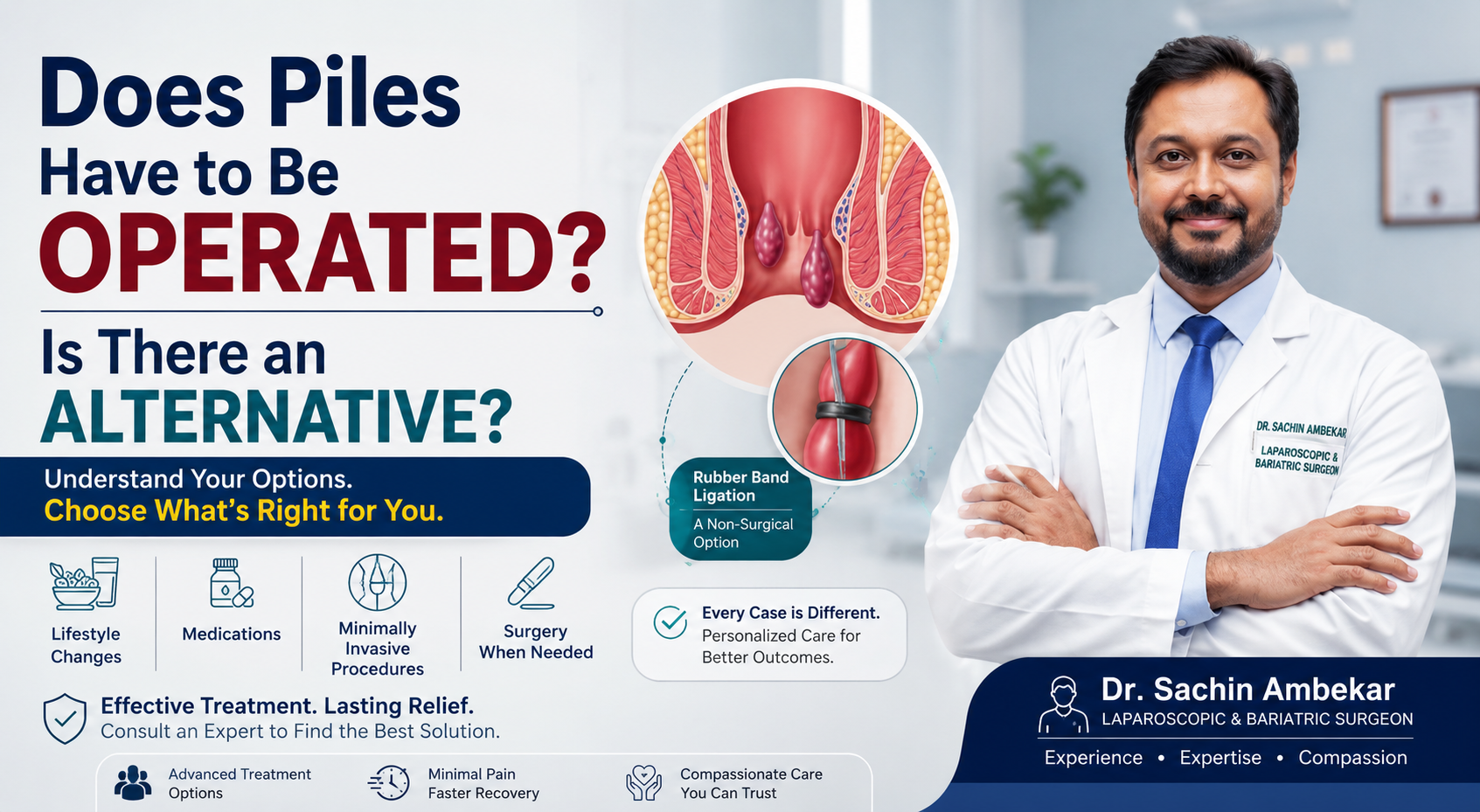
Seeing blood after passing stool or feeling a painful lump around the anus can be worrying. For many people, the first thought is: “Will I need piles surgery?”
The good news is that not every case of piles (haemorrhoids) requires an operation.
Treatment depends on several factors, including the type of piles, their grade, how often they bleed, whether they prolapse, how severe the symptoms are, and whether simpler treatments have already been tried. Mild piles can often improve with dietary and lifestyle changes, medicines, or outpatient procedures. Surgery is generally considered when piles are large, persistently symptomatic, prolapsing significantly, or have not responded adequately to other treatments.
One important point, however, is that rectal bleeding should not automatically be assumed to be piles. Anal fissures, inflammatory bowel conditions, polyps and other problems can also cause bleeding. A proper examination helps identify the actual cause before deciding on treatment.
So, does piles have to be operated? Usually, no. But in some patients, Piles surgery can be the most appropriate and lasting treatment.
What Are Piles?
Piles, medically called haemorrhoids, are swollen and enlarged blood vessels and supporting tissues in and around the anus and lower rectum.
They are broadly classified into:
Internal piles
These develop inside the anal canal. They may cause:
- Bright-red bleeding during or after bowel movements
- A feeling of incomplete bowel evacuation
- Mucus discharge
- Tissue protruding through the anus in more advanced cases
Internal piles are commonly classified into four grades according to how much they prolapse.
Grade 1: The piles remain inside the anal canal and do not prolapse.
Grade 2: They come out during bowel movements but go back inside on their own.
Grade 3: They come out during bowel movements and need to be pushed back manually.
Grade 4: They remain outside and cannot be pushed back inside.
This grading is important because it helps the surgeon determine whether lifestyle measures, medication, an outpatient procedure, or surgery is more appropriate.
External piles
External haemorrhoids develop under the skin around the anus. They can cause a painful lump, especially when a blood clot forms inside the swollen vessel.
Not every painful lump around the anus is necessarily piles, which is another reason an examination can be important.
Does Every Patient With Piles Need Surgery?
No.
Many people with piles can be managed without an operation, particularly when symptoms are mild or moderate.
The first step is usually to address factors that increase pressure and irritation around the anus. This may include constipation, hard stools and repeated straining during bowel movements. Increasing dietary fibre, drinking adequate fluids and avoiding prolonged sitting on the toilet can help reduce symptoms.
For patients who continue to have symptoms despite these measures, there are also non-surgical procedures.
The choice should not be based simply on the question, “Can I avoid surgery?” A better question is:
“What treatment is most appropriate for the grade and symptoms of my piles?”
Sometimes avoiding surgery is entirely reasonable. In other cases, repeatedly delaying an appropriate procedure can mean living with bleeding, prolapse or discomfort for longer than necessary.
What Are the Alternatives to Piles Surgery?
There are several alternatives depending on the type and severity of haemorrhoids.
1. Dietary and lifestyle changes
For mild piles, improving bowel habits can make a significant difference.
The aim is simple: make stools softer and reduce straining.
Helpful measures may include:
- Eating more fibre through vegetables, fruits, whole grains and other fibre-rich foods
- Drinking sufficient water
- Avoiding unnecessary straining during bowel movements
- Going to the toilet when you feel the urge rather than repeatedly postponing it
- Avoiding prolonged sitting on the toilet
- Staying physically active
- Addressing constipation
These measures can also help reduce the chance of piles recurring.
A common pattern doctors see is that patients treat the bleeding but continue the habit that is contributing to it—for example, chronic constipation or prolonged straining. In such cases, symptoms may keep returning.
2. Medicines and topical treatments
Depending on the symptoms, a doctor may recommend creams, ointments, suppositories or medicines to relieve itching, irritation, swelling or discomfort.
If constipation is contributing to the problem, a stool-softening or laxative treatment may sometimes be recommended.
These treatments are mainly aimed at controlling symptoms and improving bowel movements. They do not necessarily eliminate large or prolapsing haemorrhoids.
It is better not to use steroid-containing creams or other medicated preparations for prolonged periods without medical advice.
3. Rubber band ligation
Rubber band ligation is one of the commonly used non-surgical treatments for suitable internal piles.
During the procedure, a small rubber band is placed around the base of the haemorrhoid. This cuts off its blood supply, and the treated tissue gradually shrinks and falls away.
The procedure is generally performed as an outpatient treatment, and patients can usually return home the same day.
Banding is particularly useful for selected internal haemorrhoids and can help patients avoid conventional surgery when appropriate.
However, it is not suitable for every type or grade of piles. Your surgeon needs to determine whether the haemorrhoid is appropriate for banding.
4. Sclerotherapy
Sclerotherapy involves injecting a solution into the haemorrhoid. The injection causes the tissue to shrink and can help control bleeding.
It may be useful for selected haemorrhoids, particularly when symptoms are mainly bleeding. However, some patients may need repeat treatment over time.
5. Infrared coagulation and other outpatient procedures
Depending on availability and the patient’s condition, procedures such as infrared coagulation or electrotherapy may be considered.
These treatments aim to reduce the blood supply to the haemorrhoid and encourage it to shrink. They can often be performed without a traditional operation.
The important point is that “non-surgical” does not mean “one treatment fits everyone.”
Your surgeon may recommend one technique over another based on the location, grade, symptoms and anatomy of your haemorrhoids.
When Is Piles Surgery Actually Necessary?
Surgery becomes more relevant when haemorrhoids are advanced or when other treatments have not provided adequate relief.
Surgery may be considered when:
- Large haemorrhoids are causing significant symptoms
- Piles repeatedly prolapse
- Grade 3 piles require frequent manual pushing back
- Grade 4 piles remain permanently outside
- There is persistent or recurrent bleeding
- Significant symptoms continue despite appropriate non-surgical treatment
- There is a substantial external component
- Outpatient treatments such as banding are unsuitable or unsuccessful
Clinical guidance generally reserves haemorrhoid surgery for patients with more severe disease or symptoms that have not responded to conservative and less invasive treatments.
This is why an experienced surgeon should assess the piles before recommending an operation.
What Types of Piles Surgery Are Available?
If surgery is required, there is not just one possible procedure.
Haemorrhoidectomy
A haemorrhoidectomy involves surgically removing the problematic haemorrhoidal tissue.
It can be highly effective for appropriately selected patients, particularly those with large or advanced haemorrhoids.
However, recovery can involve pain and discomfort, particularly during bowel movements.
Stapled haemorrhoidopexy
This procedure uses a stapling device to reposition prolapsing haemorrhoidal tissue higher inside the anal canal rather than simply cutting out the piles.
It may be considered in selected patients, although the suitability depends on the type and extent of haemorrhoids.
Haemorrhoidal artery ligation
This technique targets the blood supply to the haemorrhoids, helping them shrink. It may be an option for selected patients and is different from conventional haemorrhoidectomy.
Your surgeon should explain why a particular procedure is being recommended rather than simply suggesting surgery based on the presence of piles.
Can Grade 1 or Grade 2 Piles Be Treated Without Surgery?
Often, yes.
Early-stage piles are commonly managed with bowel habit modification, fibre, adequate fluid intake and appropriate medicines. If symptoms persist, outpatient procedures such as rubber band ligation or sclerotherapy may be considered.
That does not mean every Grade 1 or Grade 2 haemorrhoid will disappear permanently without treatment. Recurrence is possible, especially if constipation and straining continue.
What About Grade 3 and Grade 4 Piles?
The likelihood of requiring a procedure increases as haemorrhoids become more advanced.
A Grade 3 haemorrhoid prolapses and needs to be manually pushed back inside. A Grade 4 haemorrhoid remains prolapsed and cannot be reduced.
Some Grade 3 haemorrhoids may still be suitable for non-surgical or minimally invasive treatment, depending on their characteristics.
Grade 4 disease, large prolapsing haemorrhoids, or haemorrhoids with a significant external component are more likely to require surgical management.
This is why patients should not decide on surgery—or avoid it—based only on symptoms they have read about online.
Why Do Patients Often Delay Treatment?
Piles are an uncomfortable topic. Many people hesitate to consult a doctor because they feel embarrassed or assume bleeding is harmless.
Another common mistake is repeatedly using over-the-counter creams without finding out why the symptoms keep returning.
Some patients wait until a prolapsed pile becomes difficult to push back, bleeding becomes frequent, or pain begins affecting their daily activities.
There is no need to feel embarrassed. Problems around the anus are common, and surgeons routinely evaluate them.
More importantly, persistent rectal bleeding deserves proper medical assessment rather than indefinite self-treatment.
How Are Piles Diagnosed?
Diagnosis usually starts with a detailed discussion about symptoms.
A doctor may ask:
- How long have you had bleeding?
- Is the blood bright red or dark?
- Does tissue come out during bowel movements?
- Does it return inside by itself?
- Do you have constipation?
- Do you need to strain?
- Is there pain or itching?
- Have you tried any treatment already?
- Are your bowel habits changing?
Depending on the symptoms, a physical examination and examination of the anal canal may be required.
In some patients, additional evaluation may be recommended to rule out other causes of bleeding.
This is particularly important because not all rectal bleeding is caused by piles.
When Should You See a Doctor for Piles?
Consider consulting a surgeon or qualified doctor if:
- Bleeding keeps recurring
- Symptoms are getting worse
- A lump repeatedly comes out
- You need to push the pile back inside
- The pile remains outside
- Pain is persistent or significant
- Home measures have not helped
- Piles keep returning
- You are unsure whether the bleeding is actually from piles
Seek urgent medical attention for heavy or continuous bleeding, large blood clots, severe pain, or bleeding accompanied by feeling very unwell or fever.
How Can You Reduce the Risk of Piles Coming Back?
Treatment is only one part of the solution. Bowel habits matter after treatment too.
Keep stools soft
Include adequate fibre in your diet and maintain good fluid intake. If constipation is persistent, discuss appropriate treatment with your doctor.
Avoid straining
Do not sit on the toilet for long periods trying to force a bowel movement.
Stay physically active
Regular movement can support healthy bowel function and help prevent constipation.
Don’t ignore the urge
Repeatedly delaying bowel movements can contribute to harder stools in some people.
Maintain healthy toilet habits
Avoid spending unnecessary time scrolling on your phone while sitting on the toilet. It is a surprisingly common habit and can increase the time spent putting pressure on the anal area.
Follow post-treatment instructions
If you undergo banding or surgery, follow your surgeon’s instructions regarding diet, medicines, bowel movements and activity.
So, Does Piles Have to Be Operated?
No, piles do not always have to be operated.
Mild and moderate haemorrhoids can often be treated with dietary and lifestyle changes, medicines, or minimally invasive outpatient procedures such as rubber band ligation or sclerotherapy.
However, surgery may be the better option when piles are large, significantly prolapsed, persistent, associated with substantial symptoms, or resistant to other treatments.
The right approach is therefore not simply “surgery versus no surgery.”
It is about finding the least invasive treatment that is appropriate for your condition while avoiding unnecessary delay when surgery is genuinely indicated.
A consultation with an experienced surgeon can help determine the grade of haemorrhoids and discuss all reasonable treatment options before you make a decision.
Medical disclaimer: This article is intended for general educational purposes and should not replace an in-person medical examination. Rectal bleeding can have causes other than haemorrhoids. Treatment should be selected by a qualified healthcare professional after evaluating your symptoms and medical history.
5. FAQs
Do piles always need surgery?
No. Many piles can be managed with fibre, adequate fluids, constipation management, lifestyle changes and medicines. Selected internal haemorrhoids may also be treated with outpatient procedures such as rubber band ligation or sclerotherapy. Surgery is generally considered for larger, advanced or persistent haemorrhoids.
Can piles be cured without an operation?
Some patients can achieve long-term symptom control without surgery, particularly when haemorrhoids are mild and contributing factors such as constipation and straining are addressed. However, advanced prolapsing piles may require a procedure.
What is the best alternative to piles surgery?
There is no single best alternative for everyone. Rubber band ligation is a commonly used option for suitable internal haemorrhoids, while sclerotherapy, infrared coagulation and other treatments may be appropriate in selected cases.
Can Grade 3 piles be treated without surgery?
Some Grade 3 haemorrhoids may respond to minimally invasive procedures, depending on their size, prolapse and symptoms. Others may require surgery. A surgeon should assess the haemorrhoids before choosing treatment.
Are Grade 4 piles curable without surgery?
Grade 4 piles remain permanently prolapsed and cannot usually be pushed back inside. Because they are advanced, surgical treatment is more commonly considered, although the exact approach depends on the patient’s condition.
Is rubber band ligation painful?
Rubber band ligation is generally performed on suitable internal haemorrhoids because the band is placed above the most pain-sensitive area. Some patients may experience pressure, discomfort or an urge to pass stool afterwards.
What happens if piles are left untreated?
Mild piles may settle or remain manageable. Persistent or advanced haemorrhoids can continue causing bleeding, discomfort or prolapse. More importantly, ongoing rectal bleeding should be evaluated rather than automatically attributed to piles.
How long does piles surgery take?
The duration depends on the procedure and the individual case. Some haemorrhoid operations are performed as day procedures. Recovery varies, and conventional haemorrhoidectomy can involve significant discomfort during the healing period.
When should I see a piles surgeon?
You should consider medical evaluation if bleeding is recurrent, piles repeatedly prolapse, symptoms are worsening, you need to push tissue back inside, or conservative treatment has not helped. Heavy bleeding, large clots or severe pain require urgent medical attention.

Leave a Reply