

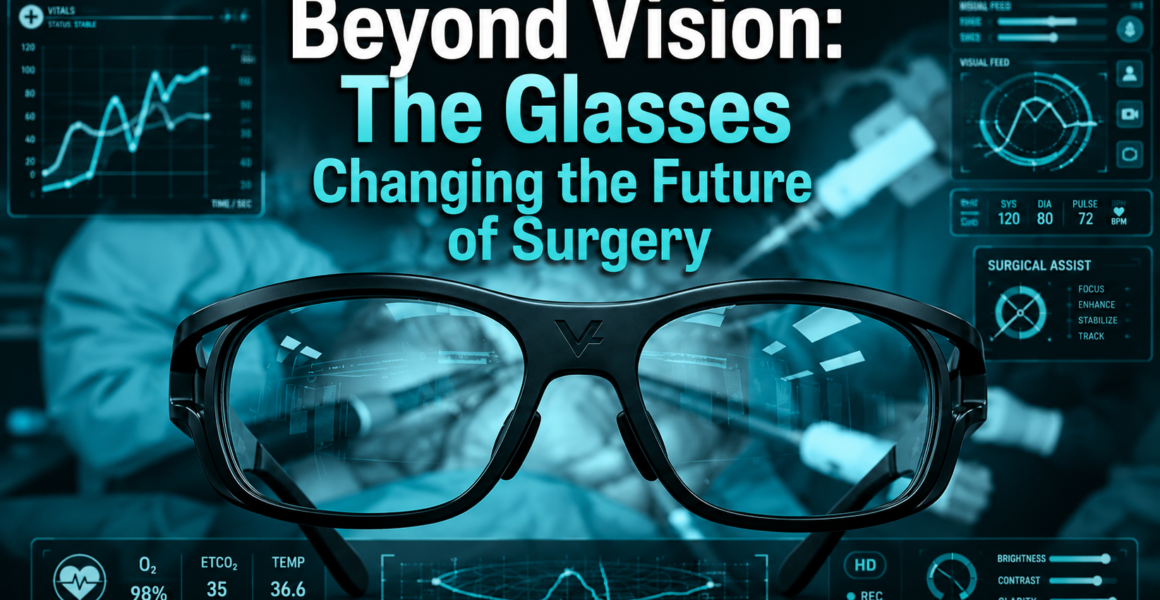
Introduction: The Future of Surgical Vision
Modern surgery represents a combination of expertise, precision, technology, and decision-making. While a surgeon’s experience and technical skill remain the foundation of successful outcomes, every surgical action begins with one essential element — visual information.
The operating room is a space where even the smallest details matter. Understanding tissue planes, identifying critical structures, judging distances, and performing delicate movements require a clear and accurate view of anatomy.
Human vision is naturally three-dimensional. Our eyes work together to create depth perception, allowing the brain to instantly understand distance, movement, and spatial relationships.
However, minimally invasive surgery introduced a unique challenge. Traditional laparoscopic systems display the internal surgical field on a two-dimensional monitor. The surgeon sees a flat image but operates within a three-dimensional environment.
To overcome this limitation, surgeons must mentally reconstruct depth using visual clues and experience.
Advanced 3D surgical visualization is changing this experience by restoring depth perception and creating a closer connection between what surgeons see and how they interact with anatomy.
Key Takeaways
- Traditional 2D laparoscopy requires surgeons to mentally estimate depth.
- 3D visualization restores natural stereoscopic vision.
- Better depth perception improves spatial understanding during procedures.
- Advanced imaging supports surgical precision but does not replace expertise.
- The future of surgery lies in combining human skill with intelligent technology.
The Evolution of Surgical Sight
The Rise of Minimally Invasive Surgery
Laparoscopic surgery transformed modern healthcare by replacing many traditional open procedures with smaller incisions and specialized instruments.
The advantages included:
- Reduced surgical trauma
- Less postoperative discomfort
- Faster recovery
- Improved patient experience
However, this advancement also created a new visual challenge.
The surgeon was no longer directly viewing anatomy. Instead, the procedure was performed through a camera system connected to a display.
The body remained three-dimensional, but the visual information became two-dimensional.
The Hidden Challenge of 2D Laparoscopy
Operating Through a Flat Image
In conventional laparoscopy, surgeons must understand a complex three-dimensional environment from a flat screen.
The brain uses indirect depth cues such as:
- Shadows and lighting patterns
- Instrument movement
- Tissue appearance
- Relative position of structures
- Previous anatomical knowledge
The surgeon must continuously interpret these signals to estimate:
- How deep a structure is
- How close instruments are to important anatomy
- How much movement is required
- The relationship between surrounding tissues
This process demands additional cognitive effort.
The Cognitive Workload of Depth Estimation
In daily life, depth perception happens automatically because both eyes provide slightly different images to the brain.
During traditional laparoscopy, this natural mechanism is limited.
The surgeon must consciously calculate spatial relationships instead of naturally perceiving them.
Over long and complex procedures, this additional visual processing may contribute to:
- Increased mental workload
- Visual fatigue
- Difficulty judging precise distances
- Greater complexity during delicate surgical steps
The limitation is not the surgeon’s ability — it is the mismatch between natural human vision and the available visual information.
The 3D Stereoscopic Advantage
Bringing Natural Depth Perception Back Into Surgery
3D laparoscopic systems recreate natural vision by providing separate images to each eye.
The brain combines these images through a process called binocular disparity, creating a realistic perception of depth.
This allows surgeons to experience the surgical field more naturally.
With 3D visualization, surgeons can better appreciate:
- Tissue depth
- Anatomical layers
- Instrument position
- Spatial relationships
- Movement within the operative field
The surgical environment becomes easier to understand because depth is perceived rather than mentally calculated.
From Depth Estimation to Spatial Awareness
One of the greatest benefits of 3D visualization is improved spatial awareness.
During complex procedures, surgeons often work near delicate structures such as:
- Blood vessels
- Nerves
- Organs
- Sensitive tissue planes
Enhanced visualization can support:
- More accurate tissue dissection
- Better instrument control
- Improved understanding of anatomy
- More confident surgical movements
By providing richer visual information, 3D technology helps surgeons make decisions based on clearer spatial understanding.
Aligning Vision With Surgical Precision
Surgery depends on coordination between:
- Eyes
- Brain
- Hands
- Surgical instruments
A surgeon observes anatomy, processes information, and translates that understanding into precise movements.
When visualization becomes closer to natural human perception, the connection between seeing and performing becomes more intuitive.
3D visualization can be especially valuable for procedures involving:
- Fine dissection
- Intricate suturing
- Reconstruction techniques
- Work near critical structures
The purpose of this technology is not to replace surgical expertise, but to enhance the information available to skilled professionals.
Where 3D Visualization Can Make a Difference
Advanced visualization can be particularly useful in procedures where depth and spatial relationships are critical.
Potential areas include:
- General surgery
- Gastrointestinal procedures
- Urological surgery
- Gynecological surgery
- Complex minimally invasive procedures
- Robotic-assisted surgical workflows
The greatest advantage often appears when surgeons must navigate narrow spaces or perform highly precise movements.
The Modern Operating Room: A Connected Surgical Environment
Today’s operating rooms are becoming increasingly technology-driven.
Many surgical suites combine different visualization systems to support teamwork.
A common setup includes:
- A primary 3D display for the operating surgeon
- Additional 2D monitors for assistants and support teams
This creates a collaborative environment where:
- Surgeons receive immersive depth perception
- Assistants maintain awareness
- The entire team remains synchronized
Modern surgery is no longer only about the surgeon’s hands — it is about the interaction between people, technology, and information.
Does Better Visualization Improve Surgical Performance?
A natural question is whether improved vision directly translates into better surgical outcomes.
Enhanced visualization may support:
- Better anatomical understanding
- Increased procedural confidence
- Improved spatial decision-making
- More efficient workflow
- Faster adaptation for trainees
However, surgical success depends on many factors, including:
- Surgeon experience
- Training quality
- Patient condition
- Procedure complexity
- Clinical environment
Technology can enhance performance, but expertise remains essential.
3D Visualization and Surgical Training
One important area of impact is surgical education.
Traditional training requires learners to develop the ability to interpret depth from a 2D image.
3D visualization may help trainees by providing:
- More intuitive understanding of anatomy
- Better instrument awareness
- Improved hand-eye coordination
- Faster development of spatial skills
However, future surgeons will still need strong foundational knowledge and technical skills.
The ideal approach combines traditional surgical principles with modern visualization tools.
Skill Enhancement or Technology Dependence?
Every major innovation creates a question about balance.
Earlier generations of surgeons developed exceptional spatial abilities while working with 2D systems. Their experience allowed them to mentally reconstruct anatomy from limited visual information.
As 3D technology becomes more common, the challenge is finding the right balance.
The future surgeon must combine:
- Fundamental surgical judgment
- Technical expertise
- Understanding of anatomy
- Ability to use advanced technology effectively
The goal is not dependence on technology, but better collaboration between human capability and digital assistance.
The Future of Surgical Visualization
The next era of surgery will likely involve deeper integration between human expertise and intelligent technology.
Future developments may include:
- Artificial intelligence-assisted visualization
- Augmented reality guidance
- Advanced imaging platforms
- Robotic surgical systems
- Real-time anatomical mapping
These innovations aim to provide surgeons with clearer, faster, and more meaningful information.
The future operating room will not remove the human element — it will strengthen it.
Conclusion: A New Dimension of Surgical Precision
The transition from 2D to 3D surgical visualization represents a major evolution in how surgeons perceive and interact with anatomy.
Traditional laparoscopy requires clinicians to mentally reconstruct depth from a flat image. 3D visualization reduces this challenge by restoring stereoscopic perception and creating a more natural surgical experience.
By improving spatial awareness and aligning visual perception with surgical action, 3D technology has the potential to support greater precision, confidence, and efficiency.
The future of surgery will not be defined by technology replacing human skill. It will be defined by how effectively innovation empowers surgeons to apply their expertise with better information, improved vision, and greater confidence.
Author
Written by: Dr. Sachin Ambekar
Role/Designation: Director – Minimal Access Surgery & Medical Director
Focus Areas: Surgical innovation, medical imaging, minimally invasive surgery, and healthcare technology
Dr. Sachin Ambekar explores advancements in surgical technology and how modern visualization systems are transforming the way clinicians understand anatomy, perform procedures, and improve patient care.
Medical Disclaimer
This article is intended for educational and informational purposes only and does not constitute medical advice, clinical recommendations, or guidance for any specific surgical procedure.
The discussion of 3D surgical visualization technology is based on general concepts in medical innovation. Surgical outcomes depend on multiple factors, including patient condition, procedure complexity, surgeon expertise, clinical environment, available technology, and individual circumstances.
Healthcare professionals should rely on current medical evidence, institutional protocols, and professional guidelines when evaluating surgical techniques or medical technologies.